Many consumers are turning to AI platforms for insights, product research, service comparisons, and to evaluate potential providers before making a decision.
Strong AI visibility can position your website as a trusted resource, leading to more qualified leads, inquiries, and sales.
Note: This blog post was co-authored by Jeff Kee, digital marketing guru and founder of Brixwork Real Estate Marketing: https://www.brixwork.com/realtors/
What is GEO, and why does it matter for your website?
Google search traffic has been down by as much as 30% in the past year. A lot of online searches are now being performed on AI platforms such as ChatGPT, Claude, Perplexity, and Grok. Some Google searches are also being intercepted by an AI-powered Gemini summary.
This is called “zero-click” search, where the platform provides the full answer directly on the results page or inside the app, so the user never needs to leave the search engine. In fact, 37 of the top 50 news domains experienced negative year-over-year traffic for that exact reason.

Example of a zero-click search result: Google’s AI Overview delivers a summarized answer directly on the results page, reducing the need for users to click through to individual websites.
AI Visibility Is a Huge Opportunity for Small Businesses and Local Services
The idea that “AI killed SEO” is not quite accurate. For small and medium-sized businesses, including real estate professionals such as Realtors, project marketers, and brokerages, customers ultimately need to speak with you. Whether they start from Google or an AI assistant, they still end up on your website.
Introducing GEO: What Is It, and How Is It Different from SEO?
SEO (Search Engine Optimization) focuses on improving your website’s visibility in traditional search engines like Google, Bing, and Yahoo. GEO (Generative Engine Optimization) shifts that focus toward AI platforms such as ChatGPT, Claude, Perplexity, Grok, and others.
GEO refers to the strategy and practice of optimizing your website so it gets recommended and cited in relevant queries across AI platforms. Being referenced as a trusted source builds authority, attracts highly motivated visitors, and can help offset declines in traditional search traffic.
Is AIO (AI Optimization) different from GEO (Generative Engine Optimization)? And what exactly is an LLM?
The terminology is still evolving. Some believe AIO and GEO mean the same thing, while others define AIO as optimizing internal workflows using AI for better efficiency and accuracy. For now, GEO is the term most widely adopted in industry discussions.
Most popular AI tools today, including ChatGPT, Claude, and Gemini, are powered by Large Language Models (LLMs). LLMs are advanced AI systems trained on massive volumes of text data. They use that information to generate human-like responses, answer questions, write content, and explain concepts clearly in plain language.
This is why your website content matters more than ever. The principle that “Content is King” still applies, especially in the age of AI. Below are practical guides to help your website appear more frequently in AI-generated conversations.
The Claim “AI Killed SEO” Isn’t True for SMBs
The idea that “AI killed SEO” isn’t accurate. For small and mid-sized businesses (SMBs), customers still need to buy directly from you. Whether someone starts their journey on Google or through an AI assistant, they ultimately need to visit your website, evaluate your offering, and take action.
Google’s AI Overviews (powered by Gemini) now surface detailed answers directly on the results page, and AI-driven search experiences continue to evolve toward more “zero-click” results. But this doesn’t eliminate the need for SEO; it shifts how visibility works.
In fact, these changes may create more opportunities for businesses that invest in deep, high-quality, and highly relevant content. As Large Language Models (LLMs) evolve, authority, clarity, and topical depth become increasingly important. Large domains may naturally appear more often in broad AI answers, but with a smart content strategy and strong niche positioning, SMBs can still build meaningful visibility in AI-driven search environments.
How AI Uses Web Search to Discover and Recommend Your Website
When someone asks ChatGPT, Claude, Gemini, or Perplexity a question, these platforms don’t comb the entire internet in real time. Instead, they perform fast, surface-level searches to gather relevant information efficiently.
Gemini leverages Google’s internal search systems.
ChatGPT uses Bing’s index along with additional data sources.
Perplexity combines its own crawling system with search engine results and applies deeper analysis to generate responses.
These systems typically rely on high-ranking, well-structured, and authoritative content to inform their answers.
Why AI Search Is Often “Shallow”
Computing power is expensive. AI platforms must balance answer quality with operational efficiency. Unless a user explicitly asks for deeper research, AI tools generally rely on the most accessible, top-ranking information they can retrieve quickly.
It’s important to remember that these systems are Large Language Models (LLMs). They generate responses based on patterns and probability - not intent, preference, or strategy. If deeper analysis is required, the user must prompt it.
The Opportunity for Businesses
AI queries are often more detailed and specific than traditional search queries. Instead of searching broad terms, users often ask conversational questions.
For example, rather than searching a short keyword phrase, a user might ask:
“What are the best options for eco-friendly office furniture under $2,000?”
“Which marketing platforms are best for small businesses in 2026?”
“What should I look for when choosing a dog grooming membership?”
This specificity creates opportunity.
You don’t need to dominate broad, highly competitive keywords to appear in AI results. Well-structured, in-depth content that clearly answers detailed questions can surface, even if you’re not a global brand.
In the AI era, clarity, expertise, and topical authority matter more than sheer size.
Content Is Still King for GEO — and Strong SEO Is the Foundation of AI Visibility
If search engine visibility supports AI visibility, then strong SEO remains the foundation for being referenced by AI platforms. The fundamentals haven’t disappeared - they’ve expanded.
In practice, websites that have invested heavily in technical SEO, structured content, and topical authority consistently perform better in AI-generated responses. Clear site architecture, optimized metadata, schema, strong internal linking, and high-quality content all increase the likelihood of being surfaced and cited.
The takeaway is simple: GEO doesn’t replace SEO, it builds on it. Strong content and solid SEO create the groundwork that allows AI systems to discover, understand, and recommend your website.
“As it turns out, SEO is the foundation of good GEO.” – Jeff Kee (Founder & Director of Brixwork)
The fundamentals still matter. A clean heading hierarchy, descriptive page titles and meta titles that accurately reflect the content, compelling meta descriptions, and a substantial amount of unique, high-quality content on core pages remain essential.
How do I see AI traffic stats on my website? Am I showing up in AI results?
Google Analytics is an essential tool for analyzing website traffic and user engagement. If you don’t already have Google Analytics installed, you can set it up in just a few minutes to start tracking where your visitors are coming from — including AI-driven sources.
How Can I Get Intel and Strategy on My Current Performance and Strategy for AI Visibility?
All this talk of AI-search, zero-clicks, and LLM seeding can be overwhelming. To understand how you’re performing in AI search and where your biggest opportunities lie, you have options. At Surf Savvy, we recommend tools like Search Atlas to gain deep insights into your website’s AI visibility. These platforms have learned how to reverse-engineer LLM behaviour, showing you which topics your brand already appears for in AI-generated results and where gaps exist. This gives you a competitive advantage by helping you show up in searches your competitors miss, and by revealing high-quality content opportunities where others may outrank you.
Building strong local citations (online listings like Yelp and Yellow Pages) will be essential for smaller businesses, as they help signal to LLMs brand legitimacy. These citations also serve as a measurable way for business owner to gauge their online word-of-mouth and overall brand presence. You can also analyze your ‘AI sentiment’ (how LLMs describe and perceive your brand) to proactively address inaccuracies, strengthen your positioning, and maintain a positive presence across AI-driven search experiences.
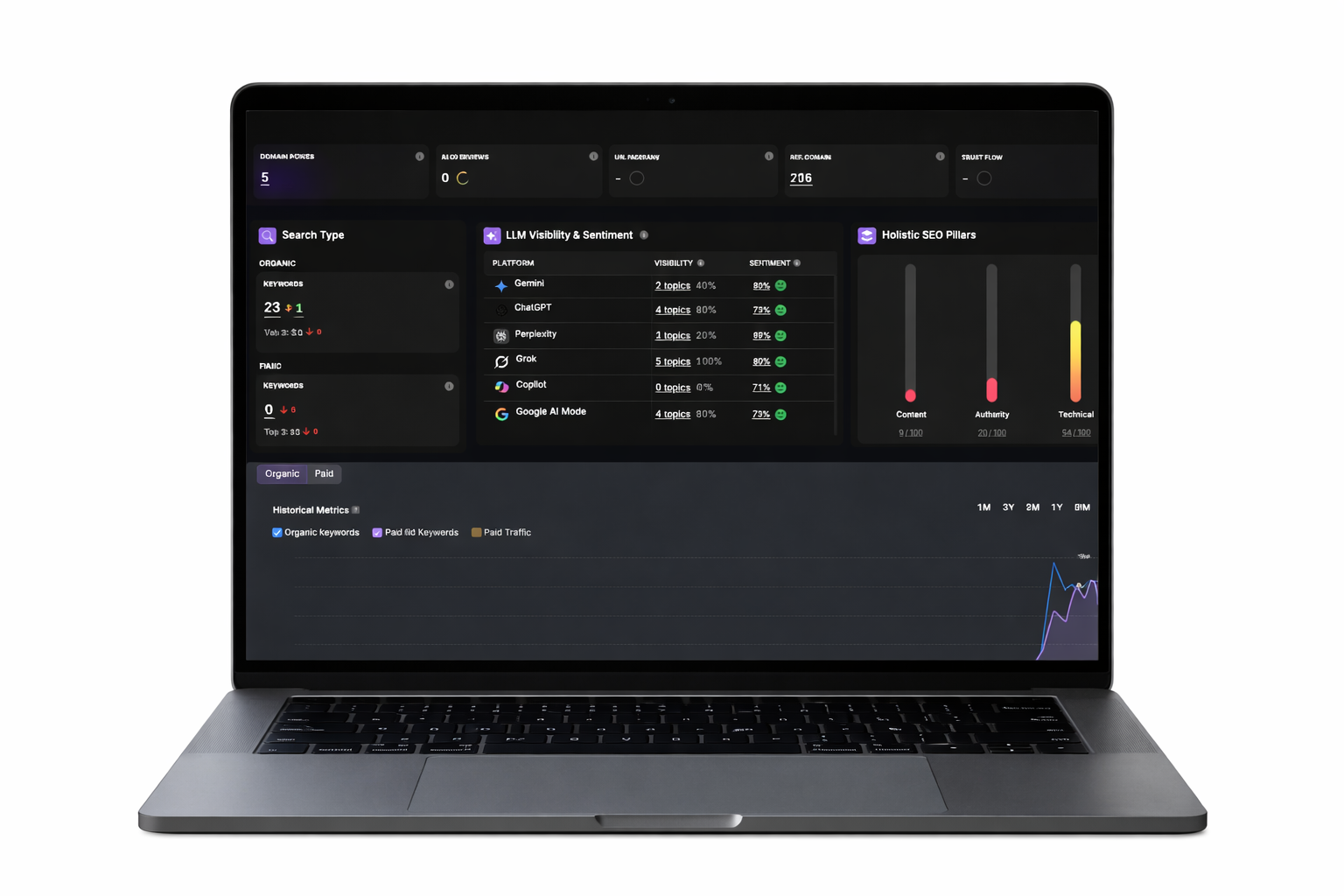
A screenshot from the Search Atlas dashboard displaying LLM visibility and sentiment across major AI platforms. Visibility indicates how many AI-generated queries the brand appears in as an answer, while sentiment reflects each platform’s perspective and overall online sentiment toward the brand.
Competing Against Goliath – Where to Strike to Be Found on AI
Going head-to-head with big brands in GEO or SEO is like trying to outshout someone with a megaphone; you won’t win by chasing the biggest, most competitive searches right away. Large corporations invest heavily in SEO every month, so smaller businesses need to be strategic about where they compete.
Instead of targeting massive, highly competitive phrases, focus on smaller, more specific searches that larger brands often overlook. For example, rather than going after broad terms like “best marketing agency” or “running shoes,” you might target more defined queries such as “B2B marketing agency for SaaS startups” or “running shoes for flat feet under $100.”
These long-tail and niche searches are typically easier to rank for and often attract more qualified, high-intent customers
“A good SEO partner helps you identify keywords that align with your strengths, where there are numerous searches but few competing businesses.” – Matt Coenen (Founder of SurfSavvy)
It’s better to be a big fish in a small pond than a small fish in a big lake. That sweet spot is where small businesses can realistically rank, grow, and stand out. In the industry, we call these high-volume, low-competition keywords, and they’re the ideal starting point for a cost-effective, strategic SEO campaign.
Want Your Website To Be Shown on AI Queries? You Must Start With SEO
If your website content is easy for search engines such as Bing or Google to scan and index, AI bots will also crawl it with ease. Furthermore, AI queries rely on web-search results first to gather the foundational information.
“As it turns out, good GEO starts with good SEO.” – Jeff Kee
Want to get started on foundational SEO for your website? Book a call here.